.png)

Automatic pH Controller for Pools NZ: The 2026 Guide to Crystal Clear Water
Your pool heater and pump are likely the most expensive investments in your backyard, yet you might be letting them slowly corrode without even realizing it. With 50% of New Zealand's aquatic facilities now over 50 years old, many local homeowners are finding that aging infrastructure requires more precise care than ever before. We understand the frustration of chasing perfect water chemistry every weekend. It's a tiring cycle of testing and manual dosing, often involving the stressful handling of corrosive hydrochloric acid. You deserve a leisure space that focuses on relaxation rather than maintenance chores.
Investing in an automatic ph controller for pools nz is the smartest insurance policy you can buy for your pool hardware. This guide will show you how automation eliminates chemical guesswork, protects your expensive equipment from acidic damage, and ensures a safer swimming environment for your family. We'll preview the latest 2026 technology, from smart sensor integration to eco-friendly CO2 regulators that offer a safer alternative to liquid acid. You'll learn how to transition to a low-maintenance setup that provides perfectly balanced water with zero manual effort, allowing you to finally enjoy your pool the way you intended.
Key Takeaways
- Maintain the ideal 7.2 to 7.6 pH range to ensure maximum swimmer comfort and protect your pool's structural integrity.
- Discover how an automatic ph controller for pools nz monitors your water chemistry in real-time, removing the need for manual testing and risky acid handling.
- Evaluate the differences between liquid acid dosing and CO2 systems to determine which chemical path best suits your family's safety and maintenance goals.
- Identify the essential factors for choosing a controller, including pool volume, surface type, and compatibility with your current salt chlorinator.
- Learn how upgrading to automated water treatment can extend the lifespan of your filtration equipment while significantly lowering your weekly maintenance effort.
Table of Contents
- Why Maintaining pH is the Biggest Challenge for NZ Pool Owners
- How Automatic pH Controllers Revolutionise Pool Maintenance
- Comparing Your Options: Liquid Acid Dosing vs. CO2 Systems
- Choosing and Installing the Right System in New Zealand
Why Maintaining pH is the Biggest Challenge for NZ Pool Owners
Understanding pH is the first step toward a stress-free swimming season. Simply put, pH measures the acidity or alkalinity of your pool water on a scale from 0 to 14. For a healthy swimming environment, you need to hit the "ideal range" of 7.2 to 7.6. This narrow window isn't just about comfort, though it certainly prevents the red eyes and itchy skin often blamed on chlorine. With 50% of New Zealand's aquatic facilities being over 50 years old, maintaining this balance is even more critical for protecting aging infrastructure from rapid degradation.
When your water drifts outside this range, your sanitizer loses its power. If the pH climbs too high, your chlorine becomes "lazy" and fails to kill bacteria or algae effectively. This is a fundamental aspect of pool sanitation principles. Conversely, if the pH drops too low, the water becomes corrosive. It begins to search for minerals to balance itself out, often finding them in your expensive pool hardware. This is why an automatic ph controller for pools nz is often viewed as an insurance policy for your backyard investment.
The Impact of NZ Weather on Your Pool Chemistry
New Zealand's unpredictable weather patterns make manual maintenance a moving target. Heavy rainfall, a frequent guest in regions like Auckland and Northland, is naturally acidic and carries contaminants that lower your pool's total alkalinity. This creates "pH bounce," where levels fluctuate wildly and become difficult to stabilize. Additionally, our high UV levels accelerate chemical degradation. As your salt chlorinator works overtime to compensate for chlorine loss, it naturally raises the pH. It's a constant battle that manual "set and forget" dosing simply can't win.
How Unbalanced Water Destroys Expensive Equipment
The financial consequences of poor pH control are significant. Acidic water is aggressive; it will eat through the copper heat exchangers in your pool heat pumps and perish the rubber seals in your filtration pump. On the other end of the scale, high pH causes calcium to fall out of suspension. This results in white, crusty scale buildup on your salt chlorinator cells, rendering them useless and potentially voiding warranties. Over time, these fluctuations also take a toll on the pool's physical structure. They cause plaster surfaces to pit or vinyl liners to lose their elasticity and crack prematurely. Maintaining a steady automatic ph controller for pools nz setup prevents these costly repairs before they start.
How Automatic pH Controllers Revolutionise Pool Maintenance
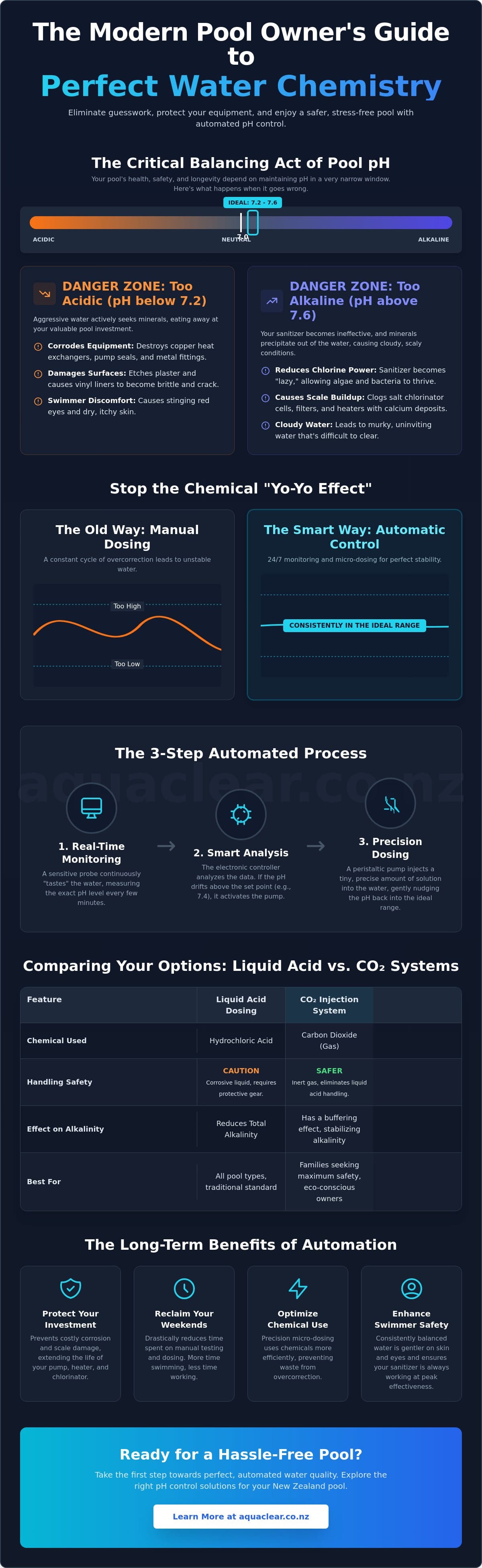
Manual maintenance often feels like a game of catch-up. You test the water, realize the pH is too high, and add acid. This creates a "yo-yo effect" where the water swings from one extreme to the other, never quite settling in the sweet spot. An automatic ph controller for pools nz changes this dynamic entirely. Instead of reactive corrections, the system provides proactive stability. It consists of three main parts: a smart electronic controller, a sensitive probe, and a precise dosing pump. Together, they work as a 24/7 guardian for your pool's health.
The safety benefits are immediate and significant. You no longer have to handle heavy containers of hydrochloric acid or worry about dangerous "splash-back" when pouring chemicals. By automating this process, you create a safer environment for your family and yourself. This level of control aligns with global standards like the CDC water quality guidelines, which emphasize the importance of consistent chemical levels for public safety and sanitation. Precision dosing ensures that your water stays balanced without the guesswork, protecting both your swimmers and your equipment.
The Science of Real-Time Monitoring
The heart of the system is the probe. This sensor sits in your plumbing and measures the electrical potential of the water. It effectively "tastes" the pool every few minutes. While test strips are subjective and depend on your eyesight, a digital controller provides a clear, objective readout. To keep this accuracy high, you'll simply need to perform a quick calibration of the probe once or twice a season. It's a small task that ensures your system remains a reliable source of truth for your water quality.
Precision Dosing: Efficiency Meets Safety
Precision is where the real magic happens. Most modern systems use peristaltic pumps. These pumps move chemicals by squeezing a flexible tube, delivering tiny, exact droplets rather than a flood. This slow delivery ensures the acid mixes thoroughly with the water before it reaches your swimmers or your equipment. Built-in "over-feed" protection is a standard feature in high-quality units. This safety switch stops the pump if it detects it's dosing for too long without a change in pH, preventing accidental chemical dumps. For the best results, you can explore integrating your controller with a modern salt chlorinator to create a fully synchronized water treatment hub that manages both sanitation and balance automatically.
Comparing Your Options: Liquid Acid Dosing vs. CO2 Systems
When selecting an automatic ph controller for pools nz, you generally face two primary paths. You can choose a system that doses liquid acid or one that injects carbon dioxide (CO2) gas. While both technologies aim for the same result, the chemical journey they take is quite different. Your choice often comes down to your pool's specific water chemistry and your personal comfort with handling chemicals. Both systems are highly reliable, but they demand different storage setups and maintenance routines.
Storage is a major factor for New Zealand homeowners. Liquid systems require a vented tank, usually holding 15 to 20 litres of hydrochloric acid. CO2 systems use pressurized gas cylinders. Both require regular checks. You'll need to monitor tank levels or cylinder pressure to ensure your automation doesn't run dry. Maintenance for liquid systems involves checking the peristaltic pump tubes for wear. These flexible tubes usually need replacing every 12 to 18 months to prevent leaks. CO2 systems are mechanically simpler but require you to manage gas cylinder swaps through a local supplier.
Traditional Liquid Acid Dosing Systems
Liquid acid dosing remains the most common choice for New Zealand backyards. It is powerful. If your pool water has high total alkalinity, liquid acid is the only way to bring both pH and alkalinity down simultaneously. This makes it the "heavy lifter" of water balance. It's an efficient solution for large pools or those that see heavy use.
However, there are trade-offs. Hydrochloric acid is highly corrosive. If you store your equipment in a small garden shed, the fumes can eventually damage metal components on your pump or heater. You must handle the liquid with care during refills to avoid spills. This system is best for owners who need maximum chemical potency and have a well-ventilated space for their equipment.
The Rise of CO2 Injection for pH Control
CO2 injection is gaining popularity across New Zealand for its safety profile. Instead of adding a liquid acid, the system dissolves CO2 gas into the water. This creates a mild carbonic acid that gently lowers the pH. A standout benefit is safety. It is virtually impossible to "crash" your pH below a safe level of approximately 6.8 with CO2. This provides a massive safety net for your pool's surfaces.
Adhering to World Health Organization guidelines for water safety is much easier when the risk of chemical over-dosing is physically limited. One thing to watch is your total alkalinity. Unlike liquid acid, CO2 can cause alkalinity to rise over time. This might require an occasional manual adjustment to keep everything in balance. This method is the perfect fit for families who want to eliminate liquid acid handling and those with indoor pool sheds where ventilation is limited.